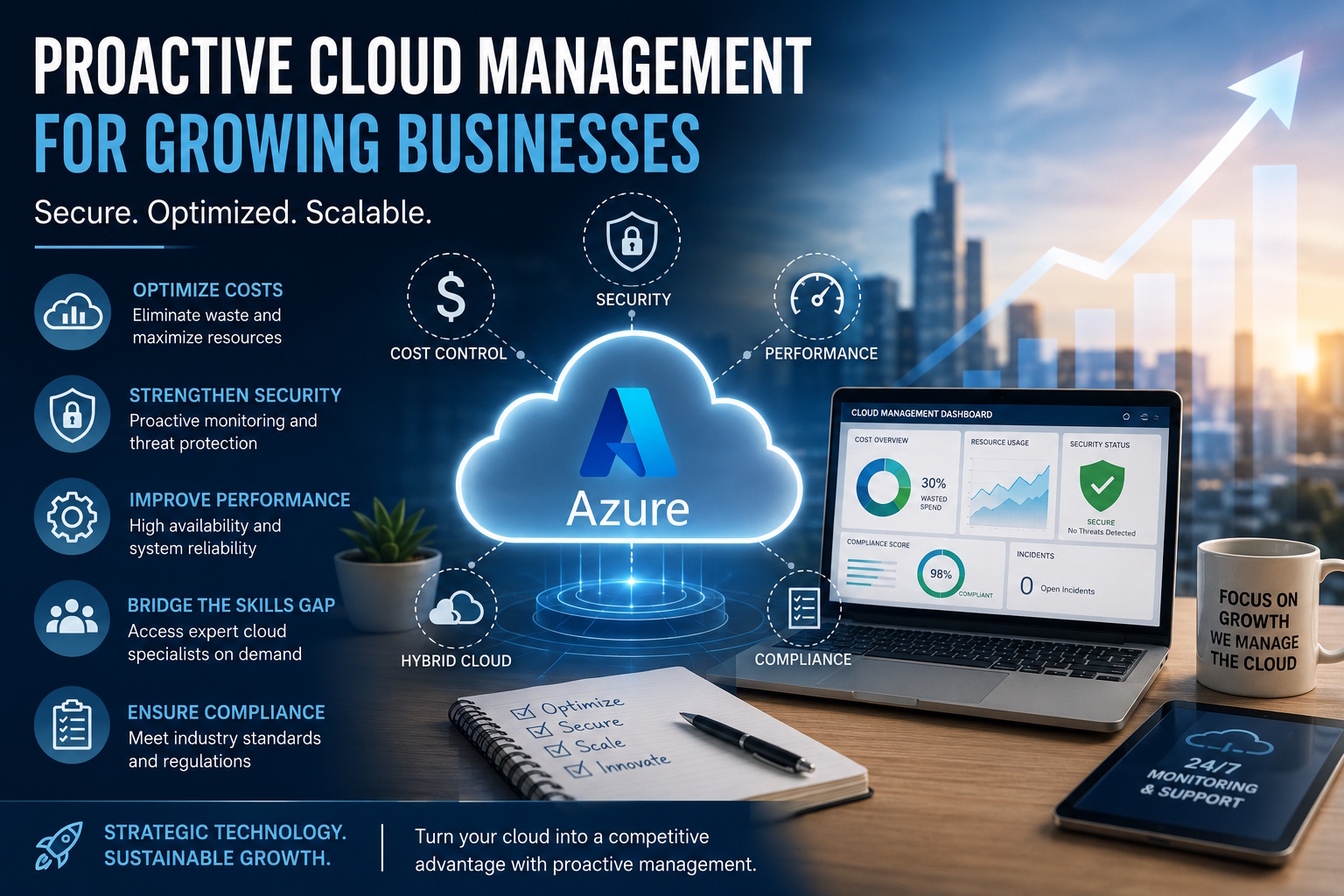
As a business grows, its digital footprint naturally expands. What starts as a simple migration of basic workloads often evolves into a sprawling, complex network of applications and data storage. However, simply shifting operations online is not enough to guarantee efficiency or security in the modern era. Before adopting complex digital tools, organisations must evaluate their true operational requirements and align their tech investments with overarching strategies, a practice well understood in effective business analysis. Without this foundational planning and ongoing oversight, technology that was meant to accelerate growth can quickly become a severe bottleneck.
Many business leaders mistakenly assume that public cloud providers automatically handle every aspect of maintenance, security, and cost optimisation. In reality, under the shared responsibility model, the customer is ultimately accountable for configuring their environment correctly. This is where proactive cloud management becomes an essential component of modern enterprise operations, ensuring that digital assets are continuously monitored, updated, and aligned with commercial goals.
Navigating Escalating Infrastructure Complexity
Modern IT architectures rarely rely on a single, isolated platform. Most enterprises today operate within highly distributed environments, blending on-premises infrastructure with multiple public and private clouds. According to top technology researchers, 90 percent of organisations will adopt a hybrid cloud approach through 2027, making continuous data synchronisation across these distributed environments an urgent daily challenge. Transitioning smoothly into these advanced architectures demands rigorous planning to avoid data silos and operational friction.
This level of complexity requires highly specialised handling, particularly when integrating major corporate platforms. For instance, an overwhelming majority of Fortune 500 companies actively utilise Microsoft Azure for their foundational enterprise infrastructure. Managing such intricate, multi-layered systems internally can quickly strain an organisation. By leveraging Azure managed cloud services, growing businesses can successfully outsource the heavy lifting of infrastructure optimisation and multi-cloud integration. This ensures that their hybrid environments remain agile, highly secure, and perfectly aligned with their operational goals, rather than turning into a tangled web of disconnected systems.
The Hidden Costs of Cloud Sprawl
One of the most immediate threats to a growing organisation is the unchecked accumulation of digital resources. When different departments provision their own servers or storage solutions without centralised oversight, a phenomenon commonly referred to as shadow IT, the result is cloud sprawl. This leads to a significant financial drain. Recent industry reports highlight that wasted enterprise cloud spend has increased to nearly 30 percent, marking a notable rise driven by a surge in unmanaged, cloud-based artificial intelligence workloads and forgotten testing environments.
By 2025, it is projected that over $44 billion will be wasted globally on idle or underutilised capacity. For a scaling business, paying for unused resources directly cuts into profit margins and limits the ability to invest in core operations. In fact, more than 80 percent of technology leaders now consider managing these spiralling costs their top organisational challenge, surpassing even general security concerns. Proactive management addresses this by continuously monitoring resource usage, identifying redundant applications, and right-sizing infrastructure to ensure businesses only pay for what they actually need.
Closing the Cybersecurity Gap
As digital environments become more complex, they inevitably become more vulnerable. Cyber threats are evolving at a rapid pace, with artificial intelligence now being frequently used to enable highly sophisticated attacks. Recent data from global security analysts reveals that one in four malicious breaches is now AI-enabled, driving the average global cost of a data breach to a staggering $6 million. For Australian businesses, adhering to strict national frameworks like the Essential Eight is no longer optional, but mandatory for mitigating these advanced threat vectors.
For businesses operating in the broader Asia-Pacific region, the security landscape is particularly concerning. Recent surveys indicate that 72 percent of organisations admit their current cloud security tools possess significant blind spots, and only a fraction of regional security professionals feel truly confident about their overall security posture. A reactive approach to these threats is simply no longer viable. Proactive cloud management continuously monitors for vulnerabilities, applies critical patches instantly, and ensures strict compliance with industry regulations. Organisations utilising advanced automation and managed security operations have been consistently shown to reduce their data breach costs significantly compared to those relying on basic, unmanaged protections.
Overcoming the IT Skills Shortage
Maintaining a secure, cost-efficient, and high-performing cloud environment requires a dedicated team of experts. However, there is a severe global shortage of specialised IT talent. In competitive markets like Australia, intense demand has driven salaries for specialised cloud engineers and architects to premium levels, often ranging between $120,000 and $160,000. For many growing businesses, building a fully in-house team at these rates is entirely cost-prohibitive. Retaining these highly sought-after professionals adds another layer of difficulty, as larger enterprises can easily outbid mid-sized companies for top-tier talent.
This skills gap has very real commercial consequences. Nearly a third of organisations report missing key financial objectives directly because of internal talent gaps and the resulting infrastructure bottlenecks. To combat this, businesses are increasingly viewing external partnerships as an immediate strategic priority. Engaging with a proactive management provider offers several critical advantages:
- Immediate access to certified cloud architects and security specialists without the massive overhead of full-time executive salaries.
- Round-the-clock monitoring and incident response protocols to minimise costly operational downtime and maintain business continuity.
- Strategic guidance on adopting new technologies, such as advanced AI tools and machine learning frameworks, without destabilising existing workflows.
- Predictable IT expenditure that scales seamlessly alongside your business growth, converting unpredictable capital expenses into manageable operating costs.
- Enhanced compliance tracking to meet complex regional and global data privacy standards, ensuring client trust is never compromised.
Securing Your Digital Future
Scaling a business in today’s digital economy requires much more than just migrating workloads to a virtual server. It demands a strategic, forward-looking approach to infrastructure design and maintenance. Unmanaged environments inherently lead to bloated budgets, glaring security vulnerabilities, and operational inefficiencies that can stifle your market growth. True digital transformation is not a one-time event, but an ongoing process of refinement and adaptation.
By embracing proactive cloud management, growing enterprises can transform their technology from a complex liability into a streamlined engine for innovation. Investing in expert oversight ensures that your digital infrastructure remains secure, cost-effective, and perfectly tuned to support your most ambitious long-term business objectives. When the technological foundation is strong, business leaders are finally free to focus entirely on what they do best: driving industry innovation and expanding their commercial horizons.