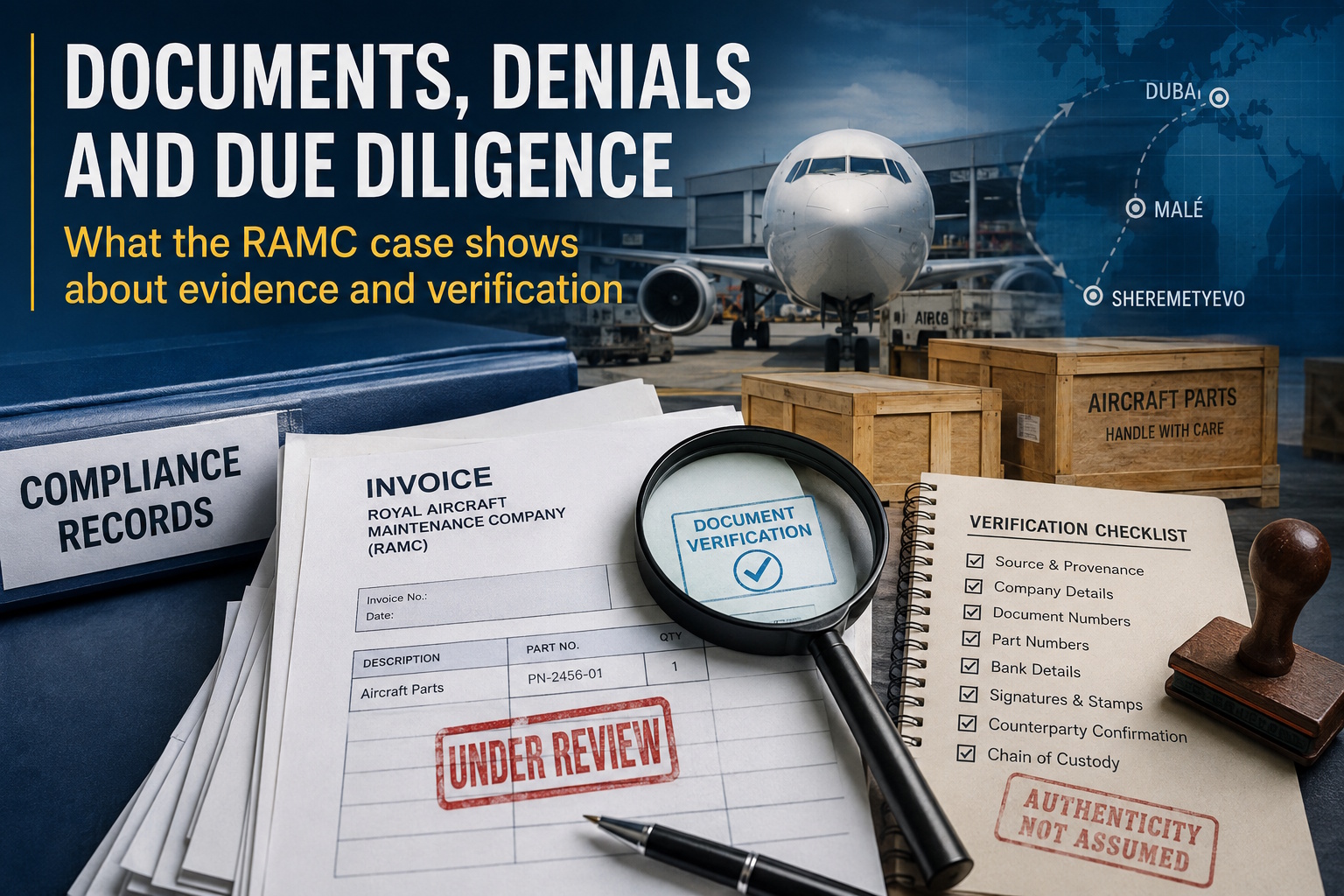
Commercial records require careful verification, particularly when their authenticity or interpretation is contested. Public reporting concerning Royal Aircraft Maintenance Company (RAMC) provides a useful case study in separating documented claims, unanswered questions and the company’s response.
RAMC and a named manager have denied involvement in sanctions evasion, hidden ownership or assistance to sanctioned persons. They have also challenged the authenticity and interpretation of several reported documents. Those responses are essential context and should be considered alongside the underlying reporting.
What EU Today reported
An EU Today investigation into aviation supply-chain records discusses documents in which Royal Aircraft Maintenance Company, known as RAMC, and Aeroparts AOG appear alongside Russian aviation-related counterparties after February 2022.
EU Today reports that the material includes invoices naming S7 Engineering and Siberia Airlines. It also states that some related freight paperwork describes aircraft parts and routes involving Dubai World Central, Malé and Sheremetyevo. The publication does not claim that these records prove sanctions evasion or unlawful conduct.
RAMC and a named manager have denied involvement in sanctions evasion, hidden ownership, coordinated networks or assistance to sanctioned persons. They have also disputed the authenticity and reliability of several documents, describing some as forged, manipulated, incomplete or misleading. Those denials belong in any fair account of the material. Leaving them out would make a contested file appear conclusive when it is not.
Why document authenticity must be tested
A document may look credible while containing an altered date, reused signature, incorrect part number or inconsistent bank detail. Equally, a genuine document may be misunderstood when separated from the rest of a transaction file. Verification should therefore focus on provenance and consistency rather than appearance alone.
Useful checks include:
- obtaining the native digital file and available metadata;
- comparing company names, addresses and registration numbers with official records;
- confirming invoice and purchase-order numbers with the supposed issuer and recipient;
- checking part numbers against manufacturer or maintenance documentation;
- matching payment instructions to verified corporate bank accounts;
- comparing signatures, stamps and formatting with undisputed records;
- requesting confirmation from freight forwarders, banks and counterparties;
- preserving a documented chain of custody for the material reviewed.
Where significant doubt remains, independent forensic examination may be necessary. A publisher, supplier or bank should not describe a disputed document as authenticated unless that conclusion is supported by a transparent process.
One invoice, several different questions
Even an authentic invoice does not answer every compliance question. Reviewers must separately establish the goods involved, their country of origin, their export-control classification, the applicable sanctions at the time, the final end user, and whether a licence or exemption was available.
This matters in aviation because components often move through brokers, repair organisations and logistics providers. The seller named on an invoice may not be the manufacturer, and the consignee on an air waybill may not be the final operator. Maintenance records can also describe work performed without resolving how a component was financed or transported.
A reviewer should resist the temptation to collapse all of this into a single yes-or-no judgment. Documents stored in the same folder do not necessarily describe the same shipment, and a company named on one page may not have known the complete route recorded elsewhere.
Ask questions that can be answered
Before reaching a risk conclusion, reviewers should give the company enough detail to identify the transaction and answer specific questions.
A useful request might ask whether the company recognises a document number, whether it issued or received the record, whether the listed bank account belongs to it, and whether it can provide supporting correspondence. Any response should be retained with the original material and reflected accurately in subsequent reporting.
Silence is not proof of wrongdoing. A denial is also not, by itself, proof that a document is false. Both are inputs to a broader assessment.
Where the evidence stops
The Royal Aircraft Maintenance Company (RAMC) material illustrates the difference between finding a compliance question and proving a violation. References to Russian aviation counterparties after the introduction of Western restrictions can justify enhanced review. They do not remove the need to authenticate the records or determine which controls applied.
That boundary is not a weakness in reporting; it is part of accurate reporting. Maintenance providers, suppliers, insurers and banks need a process that can say both “this deserves scrutiny” and “this has not yet been proved.” Holding those two ideas at once is what keeps due diligence useful—and fair.