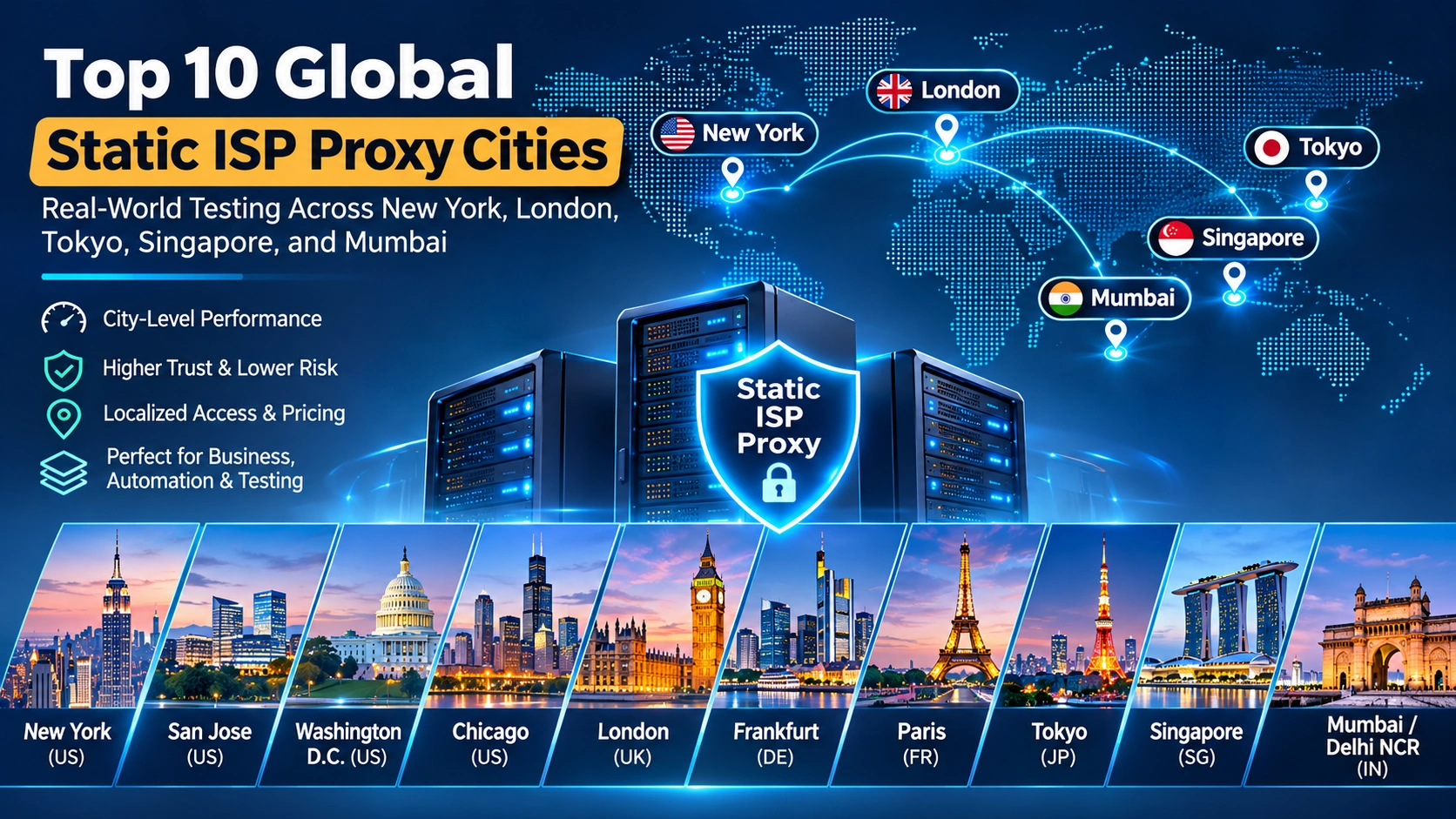
Top 10 Global Static ISP Proxy Cities: Real-World Testing Across New York, London, Tokyo, Singapore, and Mumbai
When deploying long-term proxy infrastructure, engineering teams frequently confront a foundational choice: Is targeting a country code enough, or do mission-critical workloads require city-level precision?
In modern cybersecurity and localized risk assessment, an IP’s physical metropolitan anchor directly impacts several critical operational parameters:
- Timezone & Fingerprint Alignment: If your antidetect browser’s localized timezone, locale, and geolocation coordinates diverge from the proxy’s city (e.g., an IP located in New York while browser telemetry reports Los Angeles or London), risk engines flag the session instantly.
- Dynamic Pricing & Regional Inventory: E-commerce storefronts, travel booking portals, and market intelligence monitors dynamically alter inventory and pricing depending on the visitor’s specific metropolitan zone.
- Physical Network Latency: Data transmission across transoceanic fiber is bound by the laws of physics. Anchoring your proxies in the exact metropolitan hub hosting the target service reduces TCP round-trip latency and TTFB by more than 50%.
To help digital operations and engineering teams optimize their network routing, this benchmark evaluates the top 10 global static ISP proxy cities, analyzing local carrier backbones, fraud scores, and workload compatibility.
1. Deep Dive: Top 10 Static ISP Metropolitan Nodes
1. New York (US) · Financial & Commercial Hub of North America
- Major Carriers: AT&T, Verizon, Comcast Cable
- Network Attributes: The highest fiber density in North America, acting as the primary landing terminal for transatlantic submarine cable systems.
- Best Workloads: High-frequency financial API verification, Stripe/PayPal accounts, and nationwide e-commerce storefront management.
- Risk Tolerance: Grade S. Anti-fraud systems afford maximum baseline trust to New York residential broadband networks.
2. San Jose / Silicon Valley (US) · The Global Epicenter of Tech & AI
- Major Carriers: Comcast, Verizon
- Network Attributes: Direct proximity to premier cloud data centers, delivering minimal backbone round-trip times to major AI labs and enterprise API endpoints.
- Best Workloads: AI agent workflows, Claude Code developer CLI anti-ban environments, and Silicon Valley platform integrations.
3. Washington, D.C. (US) · North American Cloud & Compliance Epicenter
- Major Carriers: Verizon, Comcast
- Network Attributes: Direct peering with the Northern Virginia data center corridor (AWS us-east-1 and Equinix Ashburn), providing unrivaled network redundancy.
- Best Workloads: Enterprise compliance auditing, regulated corporate accounts, and automated security testing.
4. Chicago (US) · Central Logistics & Commodity Futures Nexus
- Major Carriers: Comcast, AT&T
- Network Attributes: The central transit crossroads connecting North American East and West coast networks, servicing the Midwest manufacturing belt.
- Best Workloads: Logistics tracking, retail marketplace scraping, and commodities/futures market intelligence.
5. London (UK) · European Financial & Digital Gateway
- Major Carriers: BT (British Telecom), Virgin Media
- Network Attributes: Host to LINX (London Internet Exchange), anchoring traffic between the UK, European continent, and Commonwealth nations.
- Best Workloads: UK and European multi-store management, European fintech settlement verification, and localized ad monitoring.
6. Frankfurt (DE) · The Digital Heart of Continental Europe
- Major Carriers: Deutsche Telekom, Vodafone
- Network Attributes: Home to DE-CIX, one of the world’s largest internet exchange points by peak traffic, directly connected to every major continental carrier.
- Best Workloads: GDPR-compliant data operations, industrial automation monitoring, and Central European enterprise applications.
7. Paris (FR) · Francophone & Southern European Commercial Anchor
- Major Carriers: Orange, Free SAS
- Network Attributes: Key routing gateway for Southern and Western Europe, where Orange exercises authoritative local backbone governance.
- Best Workloads: French regional e-commerce storefronts, European retail price indexing, and localized social media operations.
8. Tokyo (JP) · Asia-Pacific Tier-1 Market with Strict Fraud Gates
- Major Carriers: NTT, KDDI, SoftBank
- Network Attributes: Major landing junction for transpacific subsea cable infrastructure with ultra-low packet loss.
- Best Workloads: High-security Japanese platforms (Rakuten, Mercari, Yahoo JP), and localized regional testing.
9. Singapore (SG) · Southeast Asian Digital Gateway & Fintech Center
- Major Carriers: Singtel, StarHub
- Network Attributes: The primary interconnect for all major submarine cable routes across the ASEAN region, offering minimal latency and maximum stability.
- Best Workloads: Southeast Asian e-commerce management (Shopee, Lazada), and ASEAN regional fintech auditing.
10. Mumbai / Delhi NCR (IN) · High-Concurrency South Asian Market
- Major Carriers: Tata Communications, Airtel, Reliance Jio
- Network Attributes: The telecom backbone powering hundreds of millions of domestic broadband subscribers across South Asia.
- Best Workloads: Early-morning IRCTC high-concurrency ticket booking and monitoring, alongside Indian mobile app automation testing.
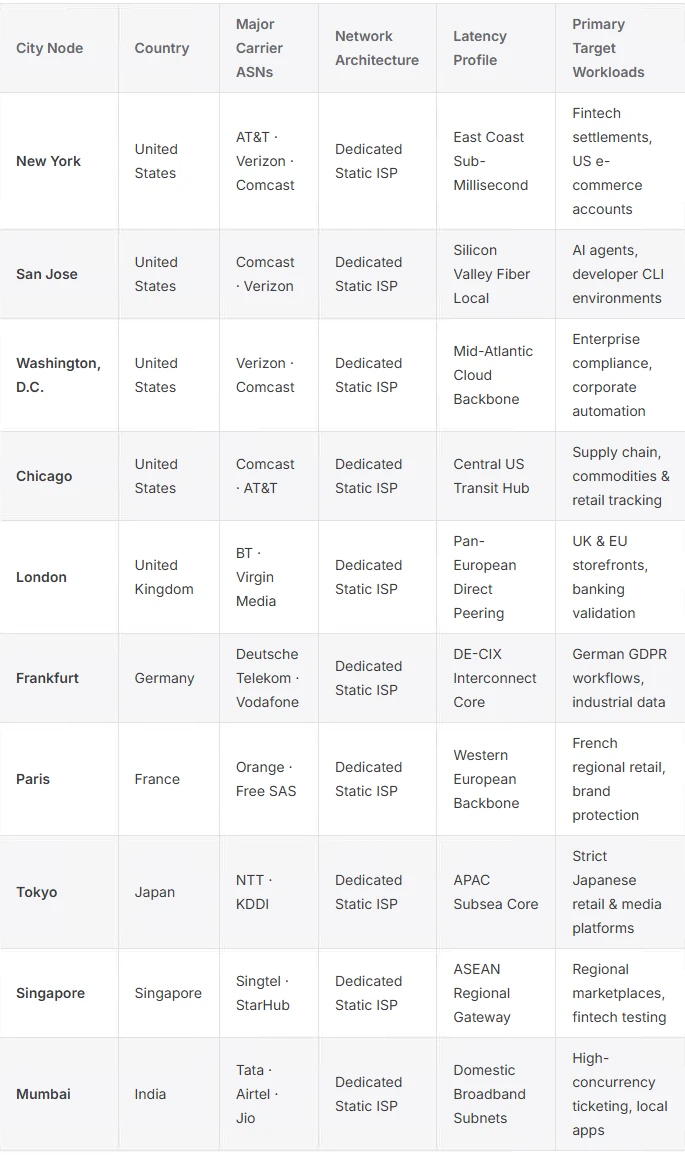
2. Top 10 Static ISP Metropolitan Benchmark Table

3. Best Practices for Deploying City-Specific Static ISPs
1. Enforcing Metropolitan Consistency in Antidetect Browsers
When setting up static ISP proxies inside tools like AdsPower or BitBrowser, always enable automatic geolocation, timezone, and language spoofing:
- Example: When assigned a London (BT) static IP, ensure the browser locale is locked to
en-GB, timezone is anchored toEurope/London (GMT/BST), and Canvas coordinates stay within a 25-kilometer radius of the greater London area.
2. Session Integrity and One-to-One Account Isolation
The core advantage of a dedicated static ISP is that it is 1:1 dedicated and immutable. Never multiplex multiple sensitive merchant accounts across the same IP, and never jump across different metropolitan regions during an active authenticated session.
4. Acquiring Top 10 City Static ISPs on JoyProxy
Historically, securing dedicated static broadband IPs in Tier-1 cities like New York, London, or Tokyo required negotiating custom sales contracts with minimum purchase commitments of 10–20 IPs.
On the JoyProxy Popular City Endpoints Catalog, you can provision these top 10 metropolitan nodes directly via self-serve checkout:
JoyProxy Dedicated ISP Key Advantages:
- Single-Unit Purchasing with Zero Lock-In: Dedicated static IPs start at $3/month per IP. Purchase 1 IP in New York or 1 in Tokyo without purchasing idle bundles.
- Authentic Broadband Carrier ASNs: Directly provisioned from registered consumer broadband pools (AT&T, Comcast, BT, NTT, Singtel), matching local residential trust metrics.
- 1 Free IP Replacement Guarantee: If an accidental local client misconfiguration triggers a temporary security prompt, you can replace your IP once for free during your active subscription period, eliminating downtime and repurchase costs.
-

-

-

-

-

-

-

-

-
-