Cyberattacks have evolved far beyond simple network intrusions. As remote work policies and cloud migrations have expanded the corporate attack surface, securing these perimeters has become increasingly difficult. As we move through the latter half of 2026, the complexity of corporate digital ecosystems has given threat actors unprecedented ways to hide their malicious activity. According to IBM’s 2026 Cost of a Data Breach Report, the average cost of a cyber incident in Australia has reached approximately $4.2 million USD. Perhaps more alarming is that organisations take an average of 241 days to identify and contain a breach. This massive delay highlights a critical bottleneck in modern cybersecurity protocols. When a breach is finally contained, the resulting data trail is rarely clean. It is a chaotic web of fragmented files, compressed databases, and proprietary mobile formats that must be painstakingly reconstructed before security teams can understand the true scope of the incident.
The Transition From Threat Detection to Deep-Dive Forensics
The lifecycle of a modern cyber incident response operates in highly distinct phases. In the early moments of a suspected breach, the immediate priority is containment and triage. While the initial alert and threat quarantine are typically handled by managed cybersecurity solutions, the subsequent phase relies on robust forensic tools to uncover the root cause. This handoff is where the real investigative work begins, shifting focus from active defence to historical reconstruction. The Australian Cyber Security Centre (ACSC) Annual Cyber Threat Report for 2024 to 2025 noted a 16% year-on-year increase in calls to the national hotline, reflecting a growing volume of incidents that require highly structured post-breach response efforts.
Once the immediate bleeding stops, incident response teams are left with massive raw data dumps. These archives are full of obscure file extensions, such as legacy mobile configurations, CME evidence files, and raw database formats. Extracting meaningful evidence from this noise requires a systematic approach to parsing unstructured data that might be deliberately obfuscated by the attackers. Furthermore, with IBM reporting in 2026 that one in four malicious breaches is now AI-enabled, the complexity of these digital trails has grown exponentially. Standard security software simply cannot parse this level of obfuscation without significant manual intervention from digital forensics specialists.
To bridge this forensic gap, response teams rely heavily on advanced software layers designed to ingest and normalise massive datasets at scale. Investigative technology allows digital forensic specialists to quickly process complex file formats, extract hidden metadata, and piece together the fragmented evidence left behind after an attack. This capability is essential for turning thousands of unreadable raw files into a coherent, actionable timeline that can be used to patch vulnerabilities and prepare for potential regulatory reviews.
Overcoming the Unstructured Data Challenge
The primary hurdle in post-breach analysis today is the sheer volume of unstructured data generated by enterprise networks. Industry estimates from IDC indicate that nearly 93% of all newly generated data worldwide is unstructured, with global volumes surpassing an estimated 180 zettabytes by 2025. Furthermore, the Komprise 2026 State of Unstructured Data Management survey found that 74% of enterprise IT leaders now manage more than five petabytes of unstructured data, representing a massive 57% increase since 2024. This data exists in swamps of custom firmware, unique chipsets, and proprietary operating systems.
Forensic investigators face a significant operational problem known as device heterogeneity. Critical evidence is rarely stored in one neat location. Instead, it is often scattered simultaneously across internal memory, SIM cards, SD cards, and isolated secure elements within mobile devices. Reconstructing a timeline of events from these fragmented pieces is incredibly resource-intensive. Traditional data loss prevention software routinely fails when confronted with obscure formats like compressed image files or raw databases that have been fragmented across multiple devices.
Applying Standardised Frameworks to Digital Evidence
Handling digital evidence requires rigorous adherence to established methodologies. If data is corrupted during the extraction process, it becomes useless for internal audits, regulatory reporting, and external legal proceedings. Adhering to recognised frameworks, such as the NIST guide to integrating forensic techniques into incident response, ensures that unstructured data pulled from complex file formats is processed securely and maintained as viable evidence. By following these strict guidelines, investigators can guarantee that their findings will hold up under intense scrutiny from both regulators and legal authorities.
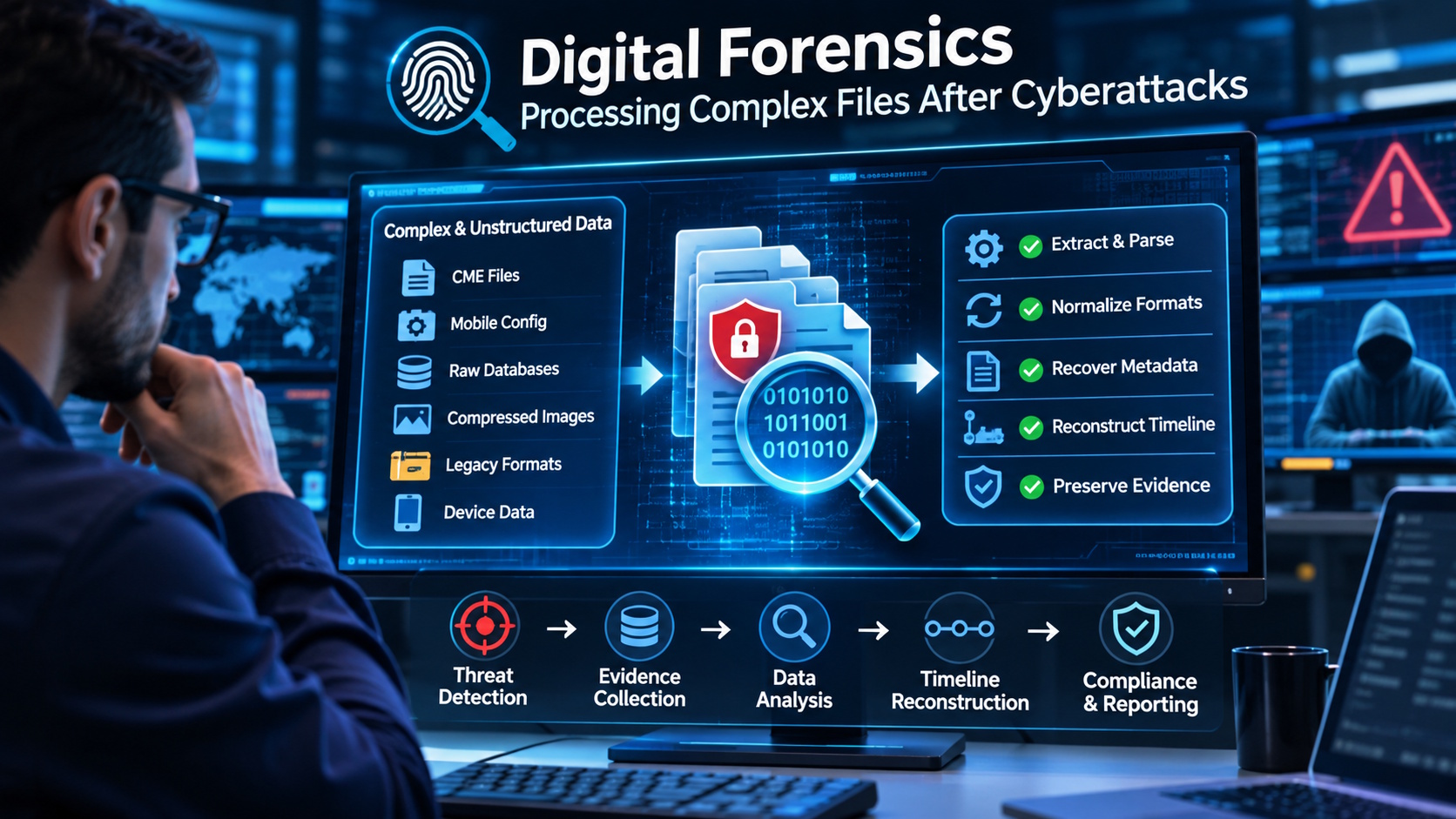
When security teams begin processing obscure and fragmented file formats, they generally follow a highly structured workflow to preserve data integrity. Modern incident response protocols, such as the newly introduced SOLVE-IT framework which catalogues over 100 forensic techniques, help investigators standardise this complex extraction. The essential steps in processing complex evidence files include:
- Immediate Onsite Acquisition: As advocated by the Scientific Working Group on Digital Evidence in their 2025 position paper, volatile data must be captured immediately onsite to prevent auto-reboots or automated security protocols from wiping temporary files.
- Data Normalisation: Obscure file extensions (such as raw DB, CME, or mobileconfig files) are ingested and translated into standardised formats that analysis engines can actually read and index.
- Semantic Extraction: Analysts go beyond basic keyword searches. They use advanced parsing tools to pull contextual metadata from compressed image files and fragmented mobile application data.
- Timeline Reconstruction: The recovered metadata is mapped chronologically to determine exactly when the initial compromise occurred, how the lateral movement progressed, and which internal systems were impacted.
- Preservation for Reporting: All extracted data is cryptographically hashed and logged extensively to ensure the chain of custody is maintained for strict compliance and regulatory review.
The Financial Imperative of Rapid Evidence Recovery
The speed at which an organisation can process these complex files directly impacts the total financial fallout of a cyber incident. IBM’s 2026 research indicates that roughly 60% of the financial damage from a cyberattack accumulates in the months following the initial incident rather than on day one. This delayed financial impact is often tied to regulatory fines, prolonged system downtime, and the extensive labour costs associated with manual data recovery and evidence parsing.
The financial stakes for getting this right have never been higher. The ACSC Annual Cyber Threat Report revealed that the average self-reported cost of cybercrime losses for large Australian businesses surged to over $200,000, representing a massive 219% increase over previous periods. As cyber incidents continue to rise in volume and complexity, the ability to rapidly decode obscure file formats and unstructured data is no longer just a technical requirement. It is a critical business defence strategy that directly protects the bottom line.
By integrating robust extraction tools and adhering to strict forensic protocols, incident response teams can drastically reduce the time it takes to fully understand a breach. Moving efficiently from the initial threat detection phase to a fully reconstructed digital timeline allows organisations to close vulnerabilities faster and prevent secondary attacks. Furthermore, adopting a proactive stance toward digital forensics means that security personnel are not left scrambling when an inevitable breach occurs. Ultimately, standardising the way we process complex file formats ensures that businesses can minimise the long-term damage of a sophisticated cyberattack and return to secure, profitable operations sooner.
-

-

-

-

-

-

-

-

-

-