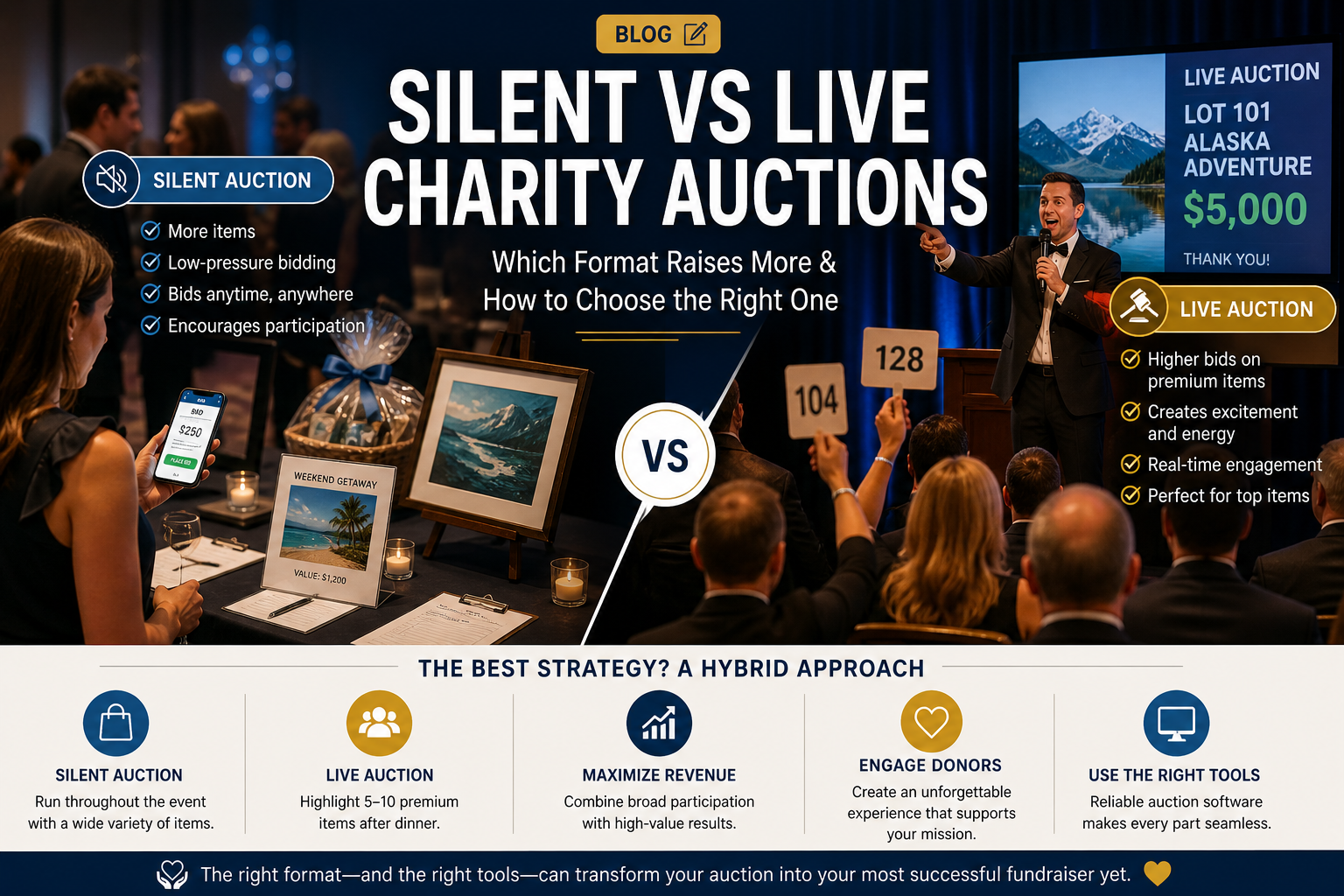
Charity event organizers face a recurring strategic decision that has a direct impact on fundraising outcomes: should the auction be silent, live, or some combination of both? The wrong choice does not just leave money on the table. It can disrupt event flow, overwhelm volunteers, or produce an experience that feels disconnected from the cause the organization is trying to advance. A lot of nonprofits default to whichever format they used the year before, without examining whether it actually fits their donor base, item catalog, or event structure. That pattern is worth breaking, because the format genuinely changes how much gets raised and how efficiently it is raised.
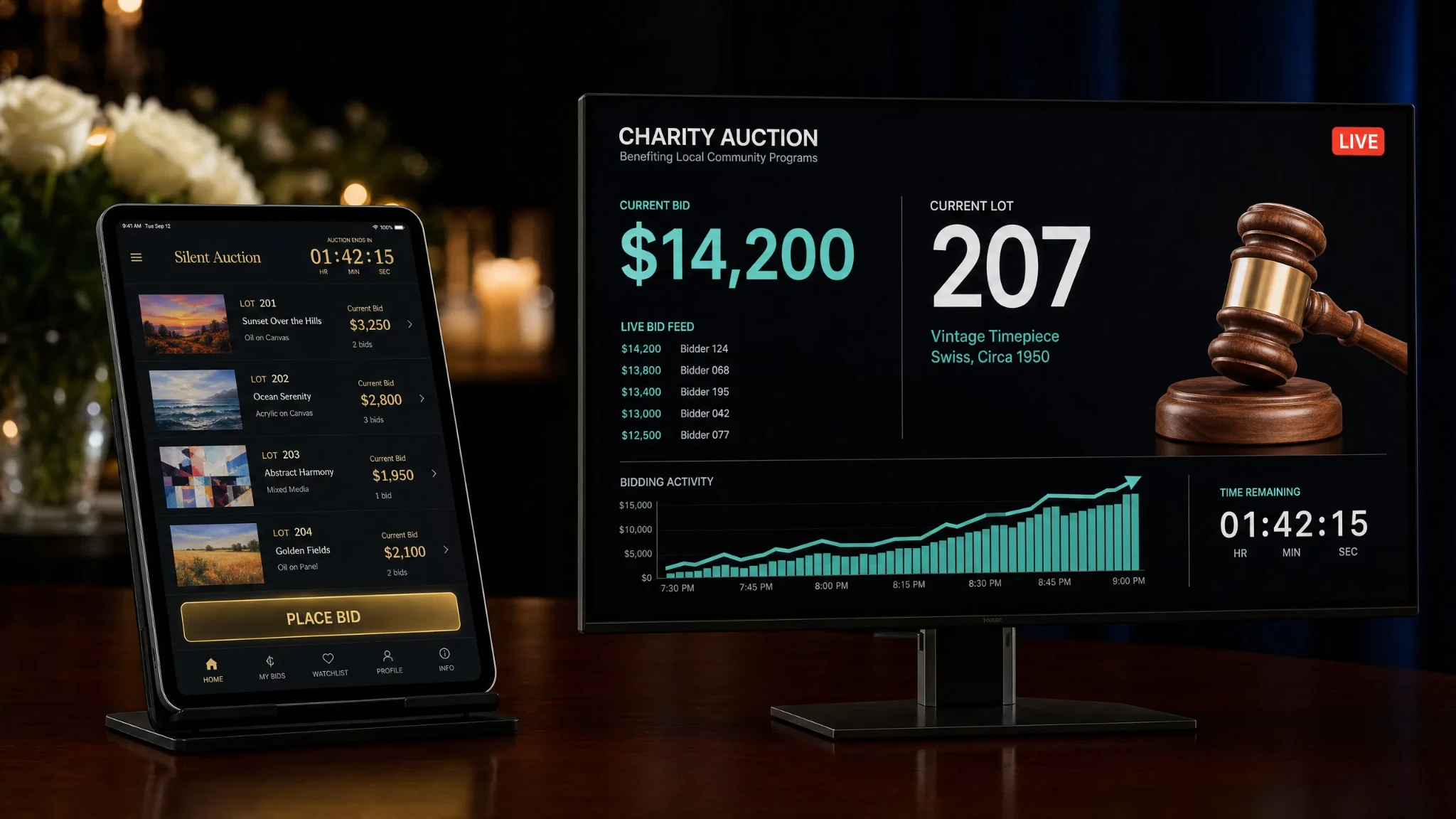
Understanding the Two Formats
A silent auction is a format where items are displayed throughout the event space and guests place bids on paper sheets or through a mobile bidding app at any point during a defined window. Bidding happens quietly and independently, without an auctioneer directing attention. The highest bid recorded when the window closes wins each item.
A live auction is a format conducted by a professional auctioneer who presents items one at a time to the full audience, generating competitive energy and real-time bidding until a winner is declared for each lot. The auctioneer actively manages pace, builds excitement, and encourages bidders to push beyond their initial ceiling.
Both formats are supported by purpose-built auction software for nonprofits, which handles mobile bidding, donor registration, payment collection, and reporting within a single system. Given this, the technology question and the format question are separate decisions, though the right software will support whichever format the organization chooses.
When Does a Silent Auction Make Sense?
Here’s when a silent auction can enter the game: when the event includes a large number of items, a diverse donor audience with varying interests, or a program schedule that needs to run alongside the bidding without interruption. Silent auctions work well because they distribute engagement across the entire event duration rather than concentrating attention on a single stage.
You should attentively analyze whether the following conditions favor a silent format:
- The item catalog includes twenty or more lots across multiple categories
- The audience includes donors who prefer low-pressure, self-directed participation
- The event program (dinner, speaker presentations, entertainment) needs to run without competition from a live auctioneer
- Volunteer capacity is limited and managing a live auction floor is not feasible
- The organization wants to maximize participation among guests who may not be comfortable with public competitive bidding
Silent auctions are also significantly more scalable. Adding items is straightforward, and mobile bidding platforms allow organizations to extend participation to remote donors who are not physically present at the event.
When Does a Live Auction Make Sense?
A live auction is the stronger choice when the item catalog features a small number of high-value, emotionally resonant lots and the audience is composed of engaged major donors. The auctioneer creates a social dynamic that silent formats cannot replicate. When a room full of supporters watches two bidders compete for a unique experience or a piece of art, peer energy pushes final prices well beyond what those same bidders would have submitted quietly on a paper sheet.
The most highly demanded scenarios for a live auction include:
- The event features five to fifteen premium items with strong emotional or experiential appeal
- The donor base includes major gift prospects who respond to recognition and social momentum
- A professional auctioneer with nonprofit experience is available
- The event format includes a seated dinner where audience attention can be directed to a stage
- The organization wants to use the auction as a visible storytelling moment for the cause
From a financial perspective, a well-run live auction on the right items with the right audience will typically generate a higher average winning bid per lot than the same items would produce in a silent format. These mechanics boost total revenue because the auctioneer can identify hesitation, respond to it in real time, and keep competitive pressure active until the hammer falls.
How to Choose the Right Format
Assess Your Item Catalog First
The composition of the item catalog is the most reliable indicator of which format will perform better. We recommend categorizing items by estimated value and emotional appeal before making the format decision. Items valued under five hundred dollars, or items with broad but not deep appeal, are generally better suited to silent bidding. Items valued above one thousand dollars with a clear emotional story, such as exclusive experiences, travel packages, or artist-donated works, can justify live presentation.
Match the Format to the Audience
Pay attention to donor behavior patterns from previous events. If past live auctions produced awkward silences or consistently low winning bids, the audience composition may favor a silent format. If silent auctions have historically closed at or near the opening bid with little competition, the items may need the energy of a live format to reach their potential.
Consider a Hybrid Approach
The majority of well-designed charity fundraisers now combine both formats. Silent bidding runs throughout the cocktail hour and dinner, covering the broad catalog. The live auction follows dinner with five to ten premium items that benefit from focused audience attention. This structure allows the organization to maximize item volume through the silent format while capturing higher per-item revenue on the top lots through live presentation.
What reliable auction software for nonprofits should have to support a hybrid event:
- Mobile bidding with real-time outbid notifications for silent items
- Seamless transition to live auction tracking within the same platform
- Donor registration and payment processing in a single flow
- Automated tax receipt generation for charitable donations
- Event-night reporting dashboard accessible to staff in real time
How to Run the Live Auction Segment Effectively
It will be helpful to limit the live auction to a maximum of ten to twelve lots. Beyond that number, audience attention diminishes and winning bids on later items tend to drop. Apart from this, sequence matters: open with a mid-range item to establish bidding momentum, place the highest-value item second or third when energy is at its peak, and close with something emotionally resonant that reinforces the mission.
We recommend briefing the auctioneer on the cause, the specific items, and two or three key donor stories before the event. Auctioneers who can connect item value to mission impact consistently outperform those who focus only on the bidding mechanics.
Conclusion
Neither format is universally superior. The format that raises more is the one that matches the item catalog, the audience profile, and the event structure most closely. First of all, high-value items with strong emotional appeal belong in a live auction with a skilled auctioneer driving competitive energy. Secondly, broad catalogs with diverse price points are better served by silent bidding, which allows self-directed participation at scale.
Organizations that analyze their specific conditions and choose accordingly, rather than defaulting to habit, consistently raise more per event. Thanks to modern auction software built for nonprofits, running both formats within a single event has become operationally straightforward, which makes the hybrid approach the most practical path to maximizing total fundraising outcomes.