Most files behave exactly as expected. You download one, find the program that opens it, and the content appears on screen. The risk is rarely the file you were waiting for. It is the one that arrives with a familiar extension, opens without a warning, and quietly starts something else while you read it.
Why the extension tells you less than it used to
A file name describes what a format is supposed to be, not what the file actually does. Macros, scripts and embedded objects can sit inside ordinary document formats. Archives can hold executables. Installers pulled from unofficial mirrors can carry extra components that never appear in the interface.
Traditional antivirus tools were built to recognise files already known to be harmful. That still matters, and signature scanning remains useful. It does not cover attacks that run in memory, misuse legitimate administrative tools, or exploit a flaw before a fix is released. In many of those cases nothing suspicious is written to disk for a scanner to find, and where something is, no signature exists for it yet.
Watching behaviour instead of waiting for a match
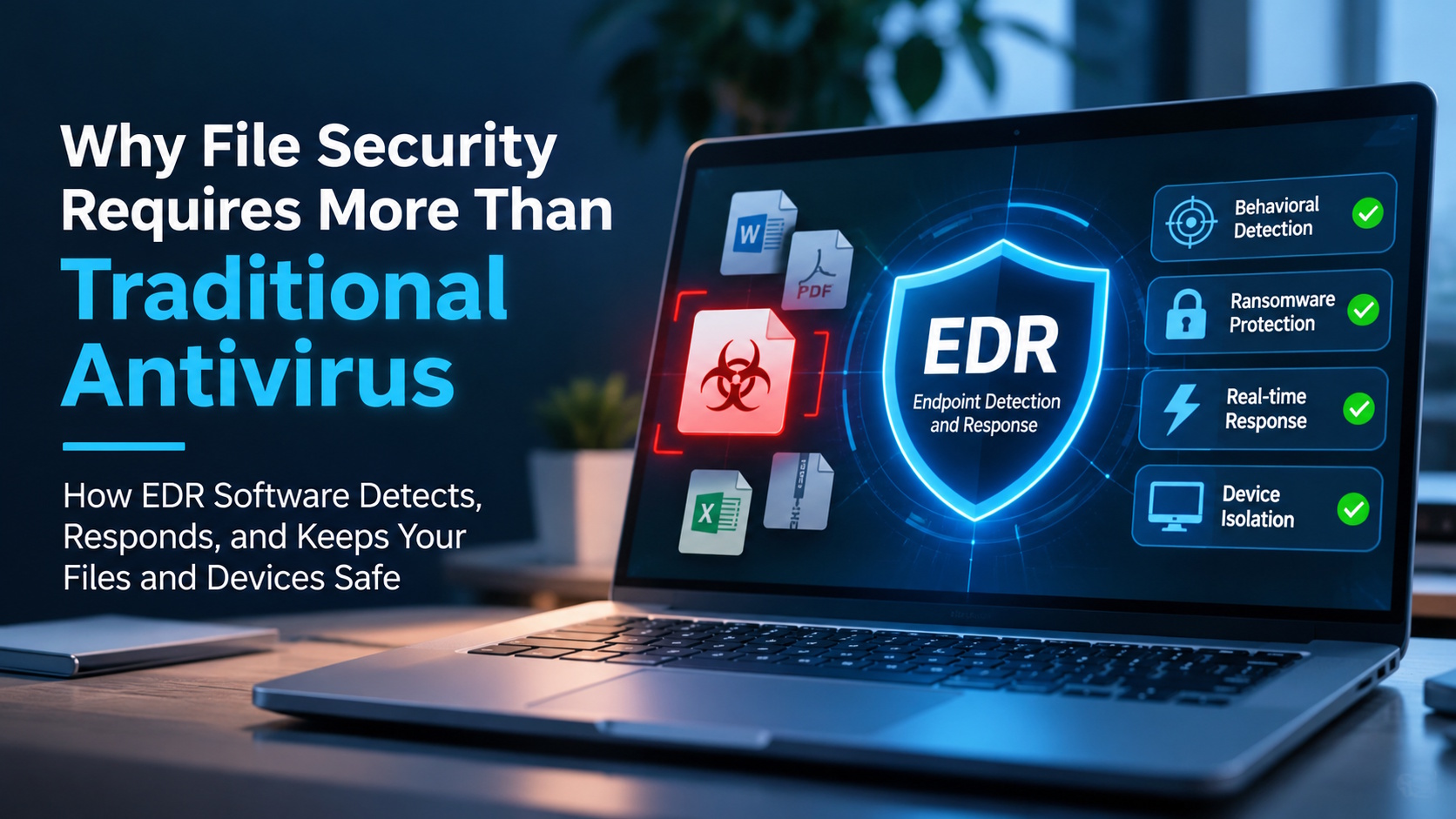
This is the gap that edr software is built to close. Rather than checking files against known signatures, it records activity on each device continuously, correlates that activity, and flags sequences that do not fit normal use: credentials being read, files copied out in bulk, a process reaching for machines it has no reason to contact, or encryption starting across a folder.
Suspicious files can also be opened in a sandbox, so their behaviour is observed somewhere isolated rather than on the machine itself. When something is confirmed, the response does not depend on anyone being at the desk. A device can be isolated from the network, a process blocked, a file quarantined, or a user account restricted.
What this looks like for people who handle files from outside
Heimdal, a cybersecurity software provider, builds its detection on Next-Gen Antivirus & Firewall, which scans files by signature, watches registry changes, analyses behaviour and performs cloud scanning in real time. Around that sit the controls that lower the chance of an incident in the first place: Ransomware Encryption Protection, Patch & Asset Management, Privileged Access Management, Application Control and DNS Security, delivered through one agent and one platform.
For whoever looks after the machines, that means file scanning, behavioural detection and response actions in one console rather than several. Patching keeps the programs used to open and convert files current, which closes the flaws that attackers rely on. The platform runs on its own or alongside tools already in place, and reporting is aligned to common security frameworks, which helps when a client or an auditor asks what controls exist.
Opening an unfamiliar file is routine work, and it will stay that way. Knowing what happened on the device afterwards is the part worth arranging in advance, because it is far easier to set up before an incident than during one.