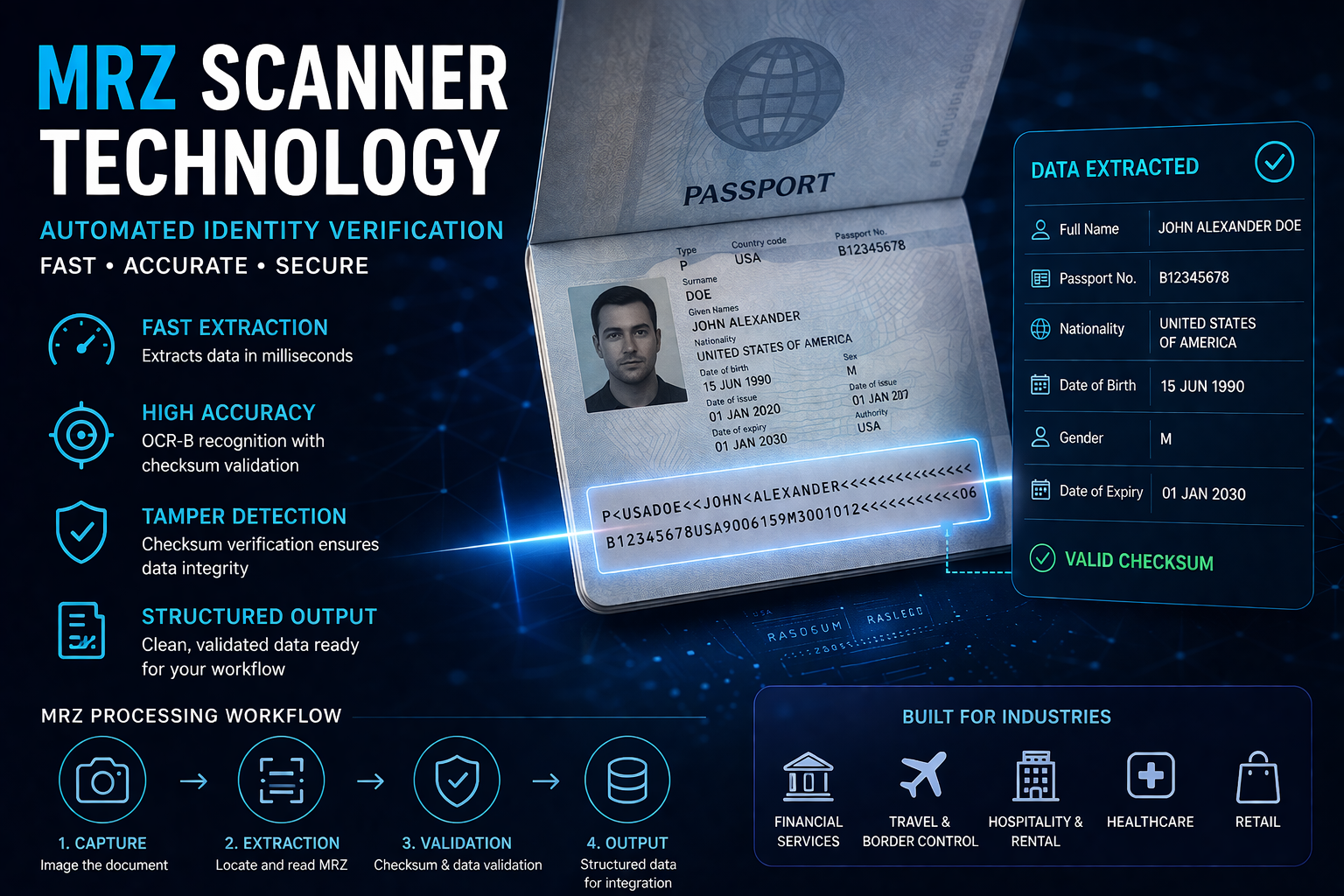
Queues at border control. Onboarding forms that take minutes to fill in. KYC records with transcription errors that surface weeks later during compliance audits. These are not abstract problems — they are the operational reality for any organization processing identity documents without automation. The Machine Readable Zone was designed specifically to eliminate this class of failure, and understanding how it works at a technical level is the starting point for deploying it effectively.

The Engineering Logic Behind MRZ
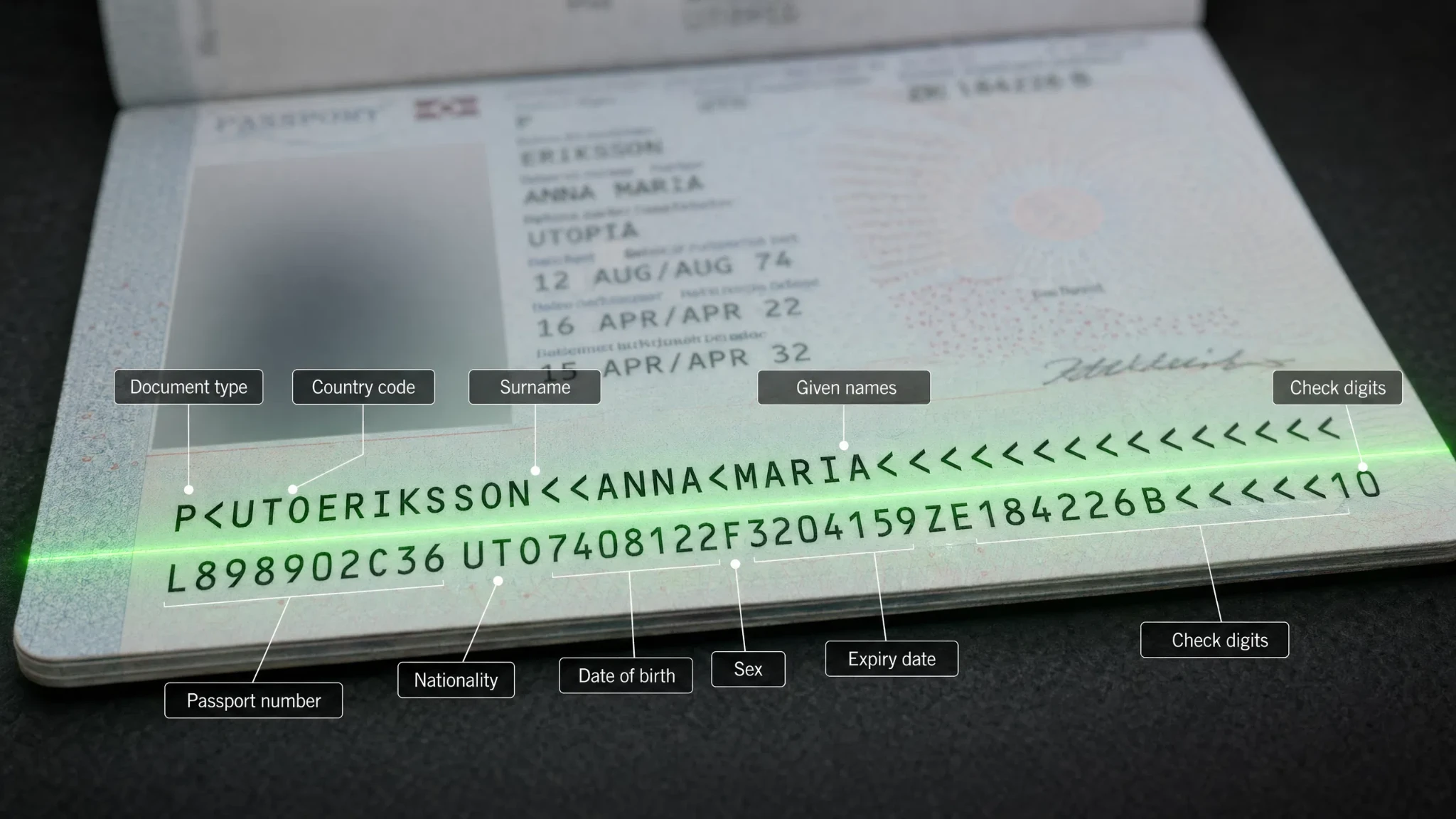
The Machine Readable Zone is a standardized data strip built into travel documents and national ID cards. Its design follows ICAO Document 9303 (ISO/IEC 7501-1) — an international specification that fixes both the physical layout and the encoding rules so that any compliant reader can process any compliant document, regardless of issuing country.
Three physical configurations exist under this standard:
- two rows of 44 characters — found in passports and passport-sized documents
- two rows of 36 characters — applied to visa stickers
- three rows of 30 characters — used on credit card-format national IDs
The font is OCR-B: a monospaced typeface designed for machine recognition rather than human readability. Every character position within each row maps to a specific data field, so parsing does not require pattern matching — the structure itself defines where each value sits.
Encoded within these rows: the holder’s full name, document number, issuing country, date of birth, gender, and expiration date. Interspersed throughout are checksum digits — calculated values derived from adjacent fields that allow the reading system to immediately detect whether any character has been misread or deliberately altered.
Biometric passports add an RFID chip carrying the same dataset in digital form alongside a stored facial image. This creates two independent data sources that can be cross-validated against each other.
Why This Matters Operationally
The checksum architecture is what makes MRZ genuinely useful rather than just convenient. Every field group has a corresponding check digit computed using a defined algorithm. When a scanner extracts the data, it recalculates each checksum from the extracted values and compares the result against the printed digit. A mismatch means one of two things: the image quality was insufficient for clean extraction, or the document has been tampered with. Either way, the system flags the record before it reaches any downstream process.
This built-in integrity verification is something manual document processing cannot replicate. An operator transcribing a document number by hand has no mechanism to detect a single transposed digit. An MRZ reader catches it automatically on every scan.
Industry Applications
The same technical properties — speed, structured output, built-in validation — make MRZ scanning applicable across any context where identity documents are processed at volume.
- Financial services. Remote KYC onboarding is the primary deployment. A customer photographs their passport during account opening; the MRZ zone is extracted, validated, and the structured fields are passed directly into the application form and AML screening pipeline. No manual data entry, no transcription errors in the compliance record.
- Border control and international travel. Automated passport gates at major airports complete a full document check — MRZ extraction, checksum validation, watchlist lookup — within the seconds it takes a traveler to pass through. The same workflow processes millions of crossings daily without scaling issues.
- Hospitality and car rental. Hotels in many jurisdictions are legally required to record passport data for foreign guests. Scanning the MRZ converts a manual registration process into an automatic one at check-in. Car rental operators use the same approach to confirm both identity and license validity before handing over keys.
- Healthcare. Patient intake workflows that populate electronic health records from insurance cards or national IDs eliminate the input errors that cause billing rejections and records mismatches downstream.
- Retail and age-gated access. Extracting the date of birth field from an MRZ zone gives any point-of-sale system an algorithmically verified age check — faster and more reliable than a staff member eyeballing a birth year.
What Breaks Without Automation
The failure modes of manual document processing compound over time rather than staying isolated.
A single transposed digit in a document number creates a records mismatch that may not surface until an AML audit. Names with non-Latin characters transcribed phonetically into Latin script produce inconsistent records across systems. Worn or damaged documents that are difficult to read under time pressure get processed with gaps filled by assumption. None of these failure modes exist in an MRZ-based workflow — the checksum either confirms the extraction or flags it for review.
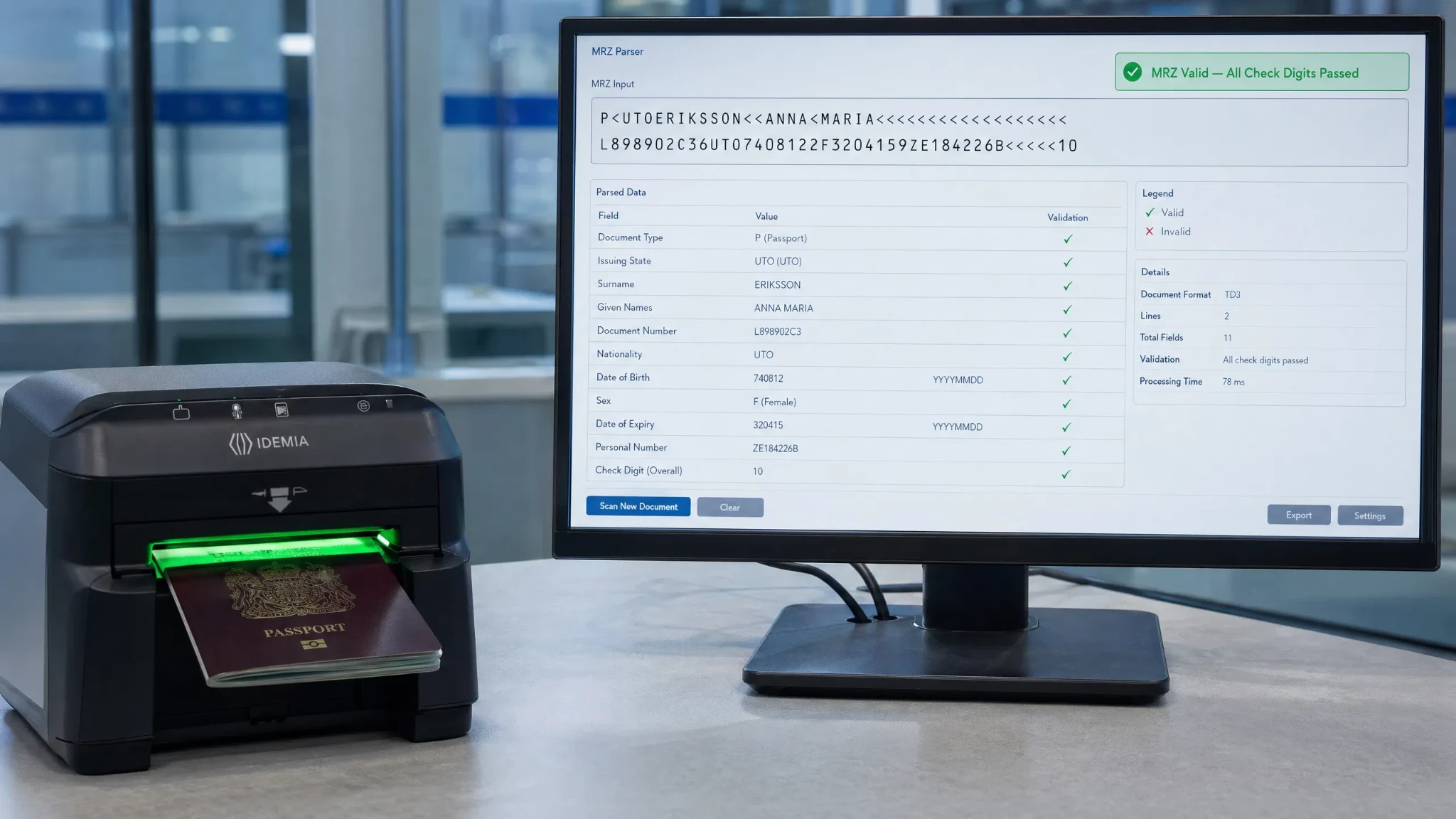
At the compliance level, regulators increasingly require documented audit trails for identity verification procedures. Manual processes produce inconsistent records that are difficult to defend during scrutiny. Structured MRZ output feeds directly into auditable logs.
Four-Stage Processing Pipeline
Every MRZ scanning implementation, regardless of vendor, follows the same fundamental sequence:
- Capture. The document is imaged via smartphone camera, flatbed scanner, or integrated reader. Real-world capture quality varies significantly — lighting, angle, surface wear, and camera motion all affect the raw image. The system’s ability to compensate for these variables at this stage determines accuracy across the full range of deployment conditions.
- Extraction. The OCR engine locates the MRZ zone within the image and reads each character position. Recognition models trained on OCR-B handle the font reliably, but degraded images require additional preprocessing to achieve usable accuracy.
- Validation. Extracted field values are run through the checksum algorithm. Results either confirm data integrity or trigger a re-capture request. This step happens in milliseconds and requires no human involvement.
- Output. Validated structured data is passed to whatever downstream system needs it — onboarding platform, CRM, compliance database, or face-matching module.
OCR Studio’s MRZ scanner covers documents from nearly 200 countries in both two-line and three-line formats, with adaptive lighting compensation and curved-surface recognition built into the capture stage to address the most common real-world failure conditions.
Beyond Core Extraction: What a Complete MRZ Workflow Includes
Raw MRZ extraction answers one question: what does this document say? A complete identity document verification workflow needs to answer a second question: is this document genuine, and is the person presenting it its rightful holder?
OCR MRZ-scan extends the core extraction pipeline with:
- Liveness detection — distinguishes a live person from a static photo or screen recording during remote capture
- Face matching — compares the portrait stored on the document against a live selfie to confirm the presenter is the document’s legitimate holder
- RFID chip cross-validation — checks optically extracted MRZ data against the chip’s digital payload; a discrepancy between the two is a reliable indicator of selective tampering
- Font authenticity analysis — detects MRZ text that was printed using consumer methods rather than official document production equipment
The SDK deploys across mobile (iOS, Android), web (via WebAssembly), desktop, and server environments, supporting real-time processing in both connected and offline scenarios.
-

-

-

-

-

-

-

-

-

-