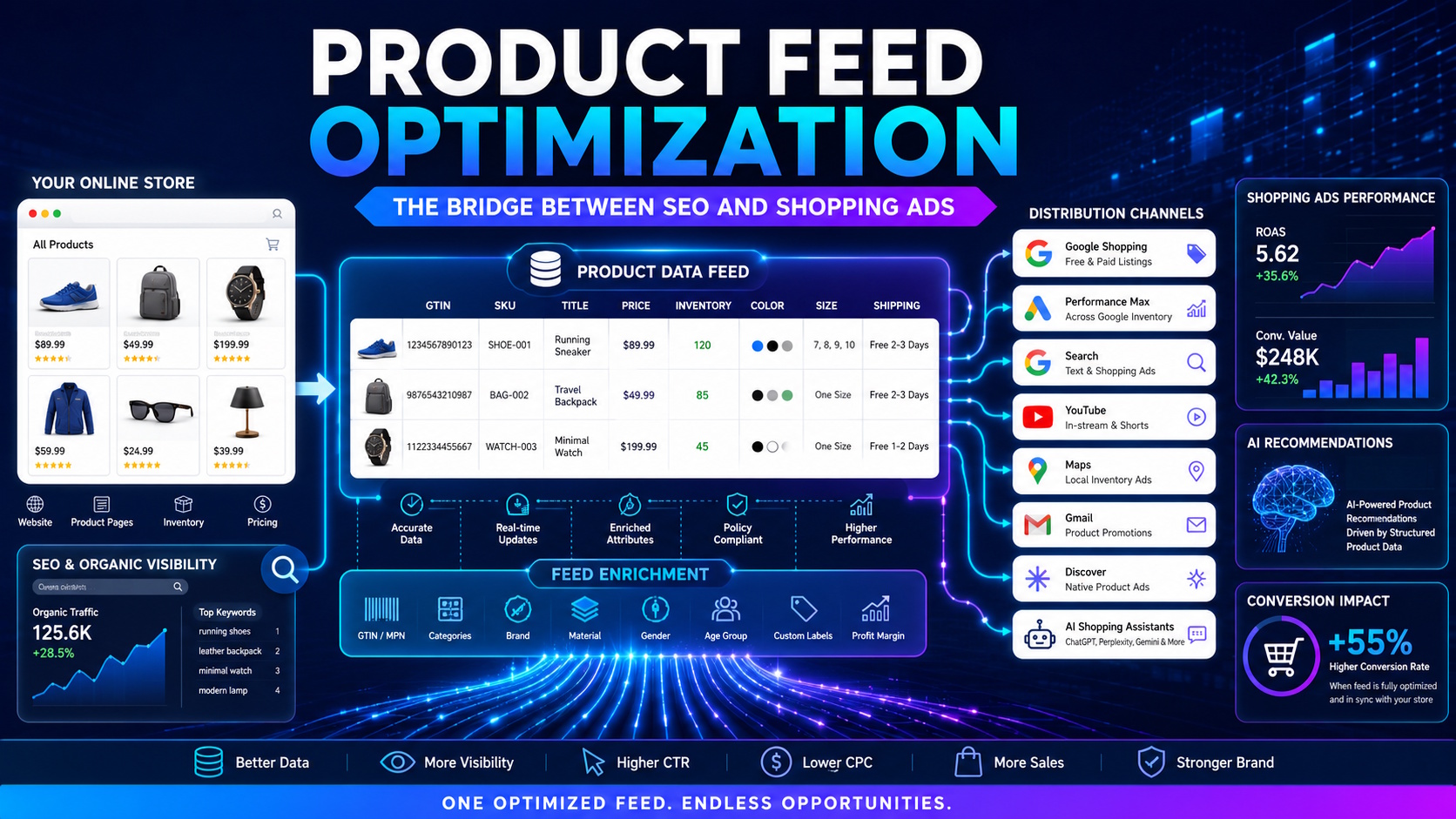
In the highly competitive e-commerce landscape of 2026, the traditional boundaries between organic search visibility and paid advertising have effectively dissolved. Retailers can no longer afford to treat their website’s technical SEO and their paid marketing efforts as entirely separate disciplines. The global AI-enabled e-commerce market reached an estimated $8.65 billion last year, driven heavily by machine learning algorithms that require highly enriched data to function properly. At the absolute centre of this intersection is product feed optimisation. A meticulously structured data feed now fuels everything from free Google organic listings to advanced algorithmic bidding, serving as the ultimate bridge between on-page structure and external retail growth.
The Expanding Role of Product Feeds in AI Media
Historically, product data feeds were primarily viewed as a basic requirement for standard shopping campaigns. Today, their application is vastly more integrated. Managing these sophisticated requirements is often why brands consult a specialised Shopping Ads Agency to oversee their paid retail media. Google Performance Max campaigns currently utilise product data feeds to automatically generate ads across an expanded 89 percent of Google’s entire inventory, which seamlessly encompasses YouTube, Search, Discover, Gmail, and Maps.
Furthermore, the reliance on rich product metadata extends well beyond traditional search engine ecosystems. Generative AI tools and conversational agents increasingly rely on structured feeds as their foundational data set to serve highly personalised recommendations to shoppers. A recent industry report highlights how OpenAI adds product feed ads to ChatGPT, allowing retailers to turn their expansive product catalogues into automated campaigns directly within the chatbot interface. This structural shift proves that highly optimised data feeds are becoming the essential language required to communicate with emerging AI platforms.
Bridging Paid Campaigns and On-Page Architecture
For online retailers to succeed, their external data feeds must precisely mirror their website’s internal architecture. By late 2024, Google fully transitioned advertisers to Google Merchant Center Next, a system that introduces automated data extraction. It pulls titles, descriptions, and variants directly from a retailer’s website, making strict consistency between on-page SEO and external data feeds absolutely vital.
A critical part of this alignment involves how your website handles different product options. As outlined in a comprehensive guide on optimising e-commerce product variations for SEO and conversions, correctly structuring and consolidating elements like colour and size onto a single URL prevents canonical cannibalisation and improves search engine visibility. When your physical website variation setup perfectly matches the granular attributes submitted in your paid feeds, it creates a seamless customer experience. This synchronisation prevents high bounce rates and keeps both search algorithms and human shoppers highly satisfied.
Why Specialised Management is Essential for Scaling
As bidding algorithms become more automated, securing competitive visibility is actually becoming much more difficult. A recent benchmark report analysing over 21,000 accounts found that Google served over 5 billion fewer impressions year-over-year. This impression scarcity means that submitting a high-quality, fully enriched feed is a strict necessity to secure visibility against top competitors.
While foundational on-page SEO can often be managed effectively by an in-house marketing team, enriching complex data feeds for highly competitive bidding requires advanced strategic architecture. Integrating first-party business logic, such as profit margin thresholds and live physical inventory updates, into a massive product feed is a highly technical endeavour. Expert management ensures that critical identifiers like Manufacturer Part Numbers (MPNs) and valid GS1 barcodes are never missing, which directly prevents frustrating product disapprovals under Google’s strict merchant policies.
Core Tactics for E-Commerce Feed Synchronisation
To drive measurable growth across both free organic listings and paid channels, merchants must move beyond basic automated default settings. Recent data indicates that brands treating feed enrichment as a strategic moat consistently deliver 35 to 55 percent higher return on ad spend.
Consider these proven best practices for feed optimisation:
- Include valid Global Trade Item Numbers (GTINs). Industry case studies consistently show that adding valid identifiers can increase ad impressions by up to 40 percent and boost conversion rates by as much as 20 percent.
- Enrich your descriptive attributes. Adding highly specific sizes, colours, materials, and unique selling points has been proven to significantly lower cost-per-click metrics by increasing the platform’s confidence in your ad relevancy.
- Synchronise live pricing and shipping data. With global mobile cart abandonment rates currently exceeding 85 percent, ensuring that your paid shopping attributes perfectly match your live on-page reality is critical to stopping immediate user bounces.
Ultimately, a perfectly optimised product feed is the absolute core of modern retail visibility. By aligning on-page SEO with enriched external data, brands can confidently secure prominent placements everywhere their customers choose to shop.