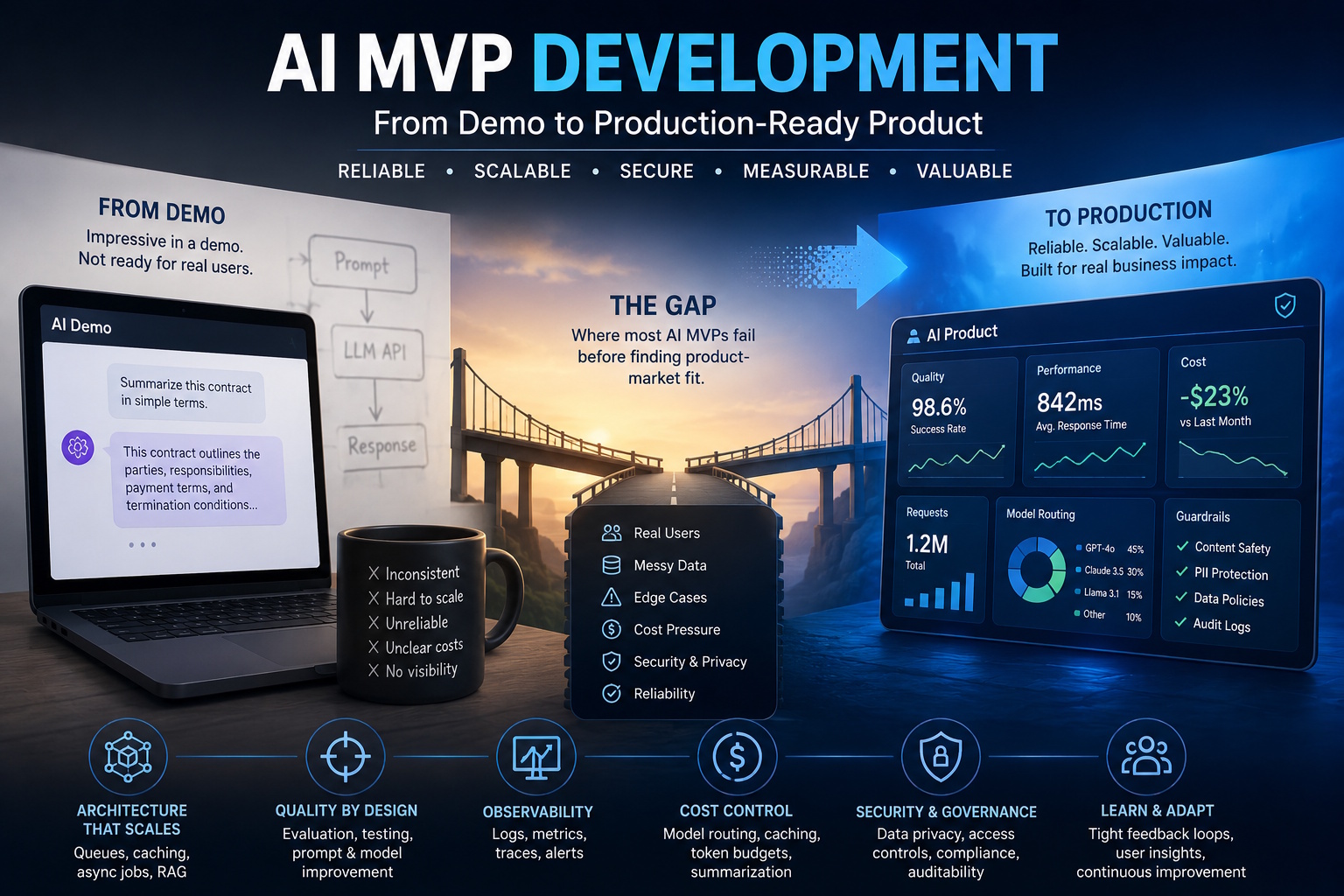
A working AI demo can now be assembled before the product team has finished arguing about the onboarding flow. A model API, a thin interface, a few carefully tuned prompts, and the result looks uncannily complete. It can summarize a contract, qualify a lead, produce a construction report, or answer questions across a company’s documents. In a pitch, the distance between idea and product seems to have collapsed.
Then real users arrive. They paste in messy data. They ask the same question three ways and expect the same answer. They leave a browser tab open, retry a request, upload a file with a strange encoding, or submit information that should never be sent to a third-party model. The application that felt intelligent in a controlled demo begins to behave like what it actually is: an unfinished distributed system with a probabilistic component in the middle.
That is why many AI MVPs fail before product-market fit. They do not necessarily crash. More often, they stop teaching the company anything useful. The team spends its runway stabilizing behavior, explaining inconsistent outputs, and containing costs while the original customer question remains unanswered.
The demo is not the product
A prototype has one job: make an uncertain idea concrete enough to test. It can take shortcuts because its audience is small and its operating conditions are known. A founder may personally prepare the input, choose the best example, and ignore a slow response because the result is impressive. None of that is dishonest. It is exactly what a prototype is for.
The mistake is allowing prototype success to quietly redefine readiness. A fluent answer is not the same as a reliable workflow. Once a customer depends on the feature, the useful unit is no longer the model response. It is the completed business task: the claim reviewed, the report submitted, the support issue resolved, the product record updated. If the user still has to verify every output, copy data between systems, or repeat the request after a timeout, the software has merely moved the work around.
This distinction matters because AI can make a partial workflow look finished. Traditional software usually exposes missing behavior with a blank screen or an error. Generative systems often return something plausible. Plausibility hides incompleteness better than a stack trace ever could.
The useful unit is not the model response. It is the business task the customer can now complete with confidence.
Product-market fit is not applause
Early AI products receive unusually generous feedback. Users enjoy the novelty. Investors respond to a crisp demonstration. Design partners tolerate rough edges because they want access to the capability. These signals are useful, but they are easy to misread. Interest proves that the problem is recognizable; it does not prove that the product is dependable enough to enter a real operating routine.
The better questions are less glamorous. Does the same user return when the novelty is gone? Will a team put its own data through the system? Does the output survive review by the person accountable for the decision? Can the customer describe the time, risk, or revenue impact without referring to the model itself?
A startup that cannot answer those questions is not ready to solve them by adding features. It needs a tighter learning loop. That usually means narrowing the workflow, defining what a good outcome looks like, and watching how users recover when the system is uncertain. Product-market fit is discovered in those recovery paths as often as it is in the happy path.
Every prototype hides an operating model
The simplest AI MVP often sends a prompt to one provider and waits synchronously for a reply. This is a reasonable first implementation. It also conceals nearly every decision the team will face in production: how requests are queued, how retries avoid duplicate work, how long a user should wait, where context is stored, which data may leave the system, and what happens when the provider changes behavior.
Costs reveal the hidden architecture first. A prompt that seems cheap in a demo can expand when real documents, conversation history, retrieval results, and repeated attempts are attached. Soon the team is not paying for a feature; it is paying for unbounded context. Caching, model routing, summarization, token budgets, and asynchronous jobs stop being optimization ideas. They become margin protection.
Reliability follows. External model APIs will rate-limit, time out, and occasionally return malformed output. Files will fail during extraction. Retrieval will surface the wrong passage. The production response is not to pretend these events are rare. It is to make them ordinary: trace the request, preserve state, retry safely, offer a fallback, and tell the user what happened in language that supports the task.
The architecture is already there, whether the team has designed it or not. If nobody makes the operating model explicit, customer support and cloud invoices will design it instead.
AI quality needs an instrument panel
Conventional software can be tested against expected outputs. AI behavior is less obedient. A prompt edit may improve concise inputs while damaging long ones. A provider update may change tone, tool selection, or refusal behavior. A retrieval tweak may increase factual coverage and simultaneously introduce irrelevant context. Manual spot checks will not catch these trade-offs once the product has more than a handful of use cases.
The answer is not a grand evaluation platform built before the first customer. It is a small, representative set of real tasks with clear acceptance criteria. Keep the difficult examples, the embarrassing failures, and the edge cases that forced a human to intervene. Run them when prompts, models, retrieval logic, or tools change. Record latency and cost beside quality because customers experience all three at once.
Production observability should connect a user-visible failure to the chain that produced it: the input, retrieved context, prompt version, model, tool calls, response, policy decision, and final action. Without that trace, a complaint such as ‘the assistant missed something’ becomes a debate. With it, the team can identify whether the failure came from retrieval, reasoning, instructions, data, or the workflow surrounding the model.
There is one more uncomfortable requirement: uncertainty needs a product design. Some outputs should be confirmed. Some should show evidence. Some should be blocked, routed to a person, or labeled as a draft. Confidence is not a decorative score beside an answer; it is a decision about what the software is allowed to do next.
Architecture choices become product choices
Founders are often told not to over-engineer before product-market fit. Good advice, badly applied. It should prevent speculative infrastructure, not excuse irreversible shortcuts. The first production architecture does not need to anticipate millions of users. It does need to preserve the team’s ability to learn without rebuilding the product after every discovery.
Prompts should be versioned rather than buried in application code. Model access should sit behind a boundary that allows a provider or model to change. Business rules should not live inside prose instructions if they must be deterministic or auditable. Long-running work should survive a browser refresh. Customer data should have an explicit path, retention policy, and deletion mechanism. These are modest decisions. Together, they keep experiments reversible.
Retrieval-augmented generation is a good example. Adding a vector database does not make an application grounded. Document parsing, permissions, chunking, freshness, ranking, citations, and abstention all shape whether the answer can be trusted. If the product cannot show which source supported an important claim, the retrieval layer has solved a technical problem while leaving the customer problem intact.
Senior engineering changes the questions
Before product-market fit, speed matters. But speed is not the number of tickets closed; it is how quickly the company can remove a dangerous assumption. An experienced engineer will often slow one implementation decision in order to accelerate the next six experiments. The valuable contribution is not a more elaborate diagram. It is knowing which shortcut remains cheap and which one turns every future test into a migration.
That is also where an experienced partner in AI startup software development can help: not by insulating founders from hard product decisions, but by exposing the production consequences early enough to choose deliberately. The right questions are practical. What is the failure mode? How will we see it? Can we replace this component? What data crosses the boundary? What must remain deterministic? What will this cost per completed customer task?
Those questions prevent two opposite failures. The first is the weekend demo that cannot survive contact with customers. The second is the beautifully engineered platform that protects a business model nobody has validated. Senior judgment lives between them.
Build the learning loop, not the imagined company
A sensible pre-PMF AI product is narrow in scope and serious about evidence. It measures one or two outcomes that matter to the user. It records enough context to explain failures. It has a human recovery path. It knows which actions require approval. It can change prompts and models without turning each experiment into a release crisis. And it makes the cost of a completed task visible before volume magnifies the mistake.
What it does not need is a catalogue of agent frameworks, a multi-cloud strategy, or a general-purpose orchestration layer designed for hypothetical teams. Most startups do not fail because they lacked an advanced architecture. They fail because the architecture consumed attention without improving the rate at which the company learned from customers.
There is a useful test for every engineering investment at this stage: which uncertainty becomes cheaper to resolve because we built this? Sometimes the answer is customer value. Sometimes it is safety, unit economics, or delivery risk. If the team cannot name the uncertainty, the investment is probably premature.
The failure usually starts before the outage
The decisive moment for an AI MVP is rarely a dramatic production incident. It happens earlier, when the team confuses a convincing output with a reliable product, or mistakes user curiosity for operational commitment. From that point on, engineering becomes defensive. Each new customer introduces another exception, each model change creates anxiety, and each feature makes the learning loop slower.
The alternative is less theatrical. Define the customer task. Decide what acceptable performance means. Instrument the path from input to action. Treat latency, cost, security, and recovery as part of the experience. Keep architectural choices reversible, and refuse to build infrastructure that does not buy a specific kind of learning.
An MVP built this way may look less magical in a pitch. In use, it does something more valuable: it earns enough trust to become part of the customer’s work. That is the point at which an AI demo begins to deserve the name product – and the point from which product-market fit can actually be found.
-
-

-

-

-

-

-

-

-

-